
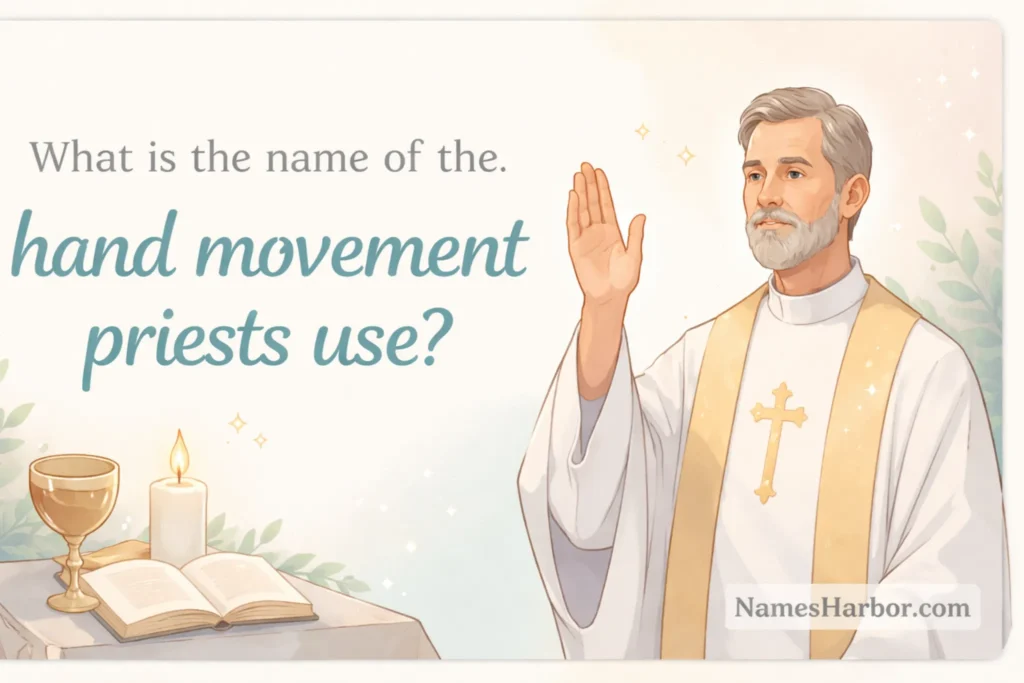
Priests play an essential role in religious services, often guiding the congregation through sacred rituals and prayers. One aspect of their ceremonial duties is the use of hand movements that carry deep spiritual meaning. These gestures are not merely for show; they are a vital part of the religious experience, helping to convey blessings, prayers, and sacred messages. But what is the name of the hand movement priests use, and why is it so significant?
In this article, we’ll explore the different types of hand movements priests use, their historical context, spiritual significance, and how they relate to various religious practices.
The Significance of Hand Movements in Religious Ceremonies
Hand movements, also known as gestures, are an integral part of many religious ceremonies. For priests, these movements serve as a form of communication with the divine, expressing humility, reverence, and authority. The act of raising, blessing, or crossing hands has deep theological significance in various traditions, particularly in Christianity.
In the context of Christianity, hand gestures made by priests during Mass, prayer, or blessings are seen as ways to channel divine power, invoke the Holy Spirit, or offer blessings to the congregation.
The “Sign of the Cross”: The Most Common Hand Gesture
The “Sign of the Cross” is perhaps the most well-known hand movement used by priests and other Christian clergy. This simple yet profound gesture involves tracing a cross on one’s body, typically from the forehead to the chest, then from one shoulder to the other. The Sign of the Cross is a declaration of faith in the Holy Trinity: the Father, the Son, and the Holy Spirit.
How It’s Done:
- Step 1: The priest places the fingers of the right hand on the forehead.
- Step 2: The hand moves down to the chest.
- Step 3: The hand then moves from one shoulder to the other, finishing with the fingers returning to the center of the chest.
This hand gesture symbolizes the core Christian belief of the cross of Christ and is commonly performed during prayers, before and after Mass, and during certain sacraments.
The “Blessing Gesture”: An Act of Divine Favor
Another prominent hand movement in religious ceremonies is the “blessing gesture.” This involves raising both hands or just the right hand over the congregation or individual to invoke God’s blessings.
In many Christian traditions, the priest extends his hand over the congregation during certain prayers or blessings, such as during baptisms, weddings, or funerals. This gesture symbolizes the impartation of divine favor and grace, allowing the faithful to experience God’s protection and love.
How It’s Done:
- The priest raises his right hand, often with fingers slightly apart, to symbolize the giving of God’s blessings.
- It may be accompanied by words like “In the name of the Father, the Son, and the Holy Spirit.”
The “Orans” Position: Hands Raised in Prayer
The “Orans” position is another significant hand gesture that is commonly used by priests during prayer. This gesture involves raising both hands to the level of the shoulders with the palms facing upwards, symbolizing the priest’s openness to receiving divine blessings.
This position is often used during moments of intercessory prayer, where the priest asks for divine help or intercedes on behalf of others.
How It’s Done:
- The priest stands with both arms raised, fingers extended, and palms facing upwards.
- This gesture emphasizes the priest’s humility and desire for divine connection.
The “Palm and Fingers Position”: Symbolizing the Holy Trinity
Priests often use a particular hand position known as the “Palm and Fingers” gesture, which involves positioning the fingers of the right hand in a specific way to represent the Holy Trinity. This gesture is typically made during blessings and other ceremonial moments.
The three fingers symbolize the Father, the Son, and the Holy Spirit. The thumb, index, and middle fingers are joined together, while the ring and little fingers are folded down.
How It’s Done:
- The priest holds up his right hand, keeping the three fingers joined.
- This signifies the unity of the Holy Trinity, an essential concept in Christian doctrine.
The “Apostolic Blessing”: A Sacred Hand Movement
The “Apostolic Blessing” is a ceremonial blessing delivered by the priest, typically during significant liturgical events, such as Easter and Christmas. During this blessing, the priest raises both hands in a special configuration while reciting prayers to invoke God’s grace upon the people.
This gesture is often accompanied by the priest pronouncing words of peace, such as “The peace of the Lord be with you always.”
The “Imposition of Hands”: A Sacred and Healing Gesture
The “Imposition of Hands” is a significant hand movement in many Christian rituals, particularly during ordinations and healings. This gesture involves the priest placing his hands on a person’s head or shoulders, symbolizing the transfer of grace and spiritual power.
In the sacrament of Confirmation, for example, the bishop or priest will lay hands on the individual to invoke the Holy Spirit and bestow spiritual gifts.
How It’s Done:
- The priest places both hands on the head or shoulders of the individual.
- This signifies the priest’s role as a channel of God’s grace.
The “Elevation of the Host”: A Moment of Sacred Reverence
During the Eucharistic celebration, the priest uses a significant hand gesture when elevating the Host (the consecrated bread) and the Chalice (the consecrated wine). This action is performed during the consecration of the elements and symbolizes the presence of Christ in the Eucharist.
The elevation of the Host is done as a sign of reverence and to allow the congregation to witness the sacredness of the moment.
How It’s Done:
- The priest raises the Host and Chalice above his head, holding them in both hands.
- This is accompanied by a moment of silent prayer or words of consecration.
The “Raising of the Cup”: Symbolizing the Blood of Christ
Similar to the elevation of the Host, the “Raising of the Cup” is a hand gesture performed during the Eucharistic celebration. The priest raises the Chalice containing the consecrated wine, which represents the Blood of Christ. This is a sacred moment in which the faithful remember Christ’s sacrifice.
How It’s Done:
- The priest lifts the Chalice, holding it high, to signify the Blood of Christ.
- It is done with reverence and devotion.
Hand Movements Across Different Christian Denominations
While many hand gestures are common across Christian denominations, some denominations may have unique variations of these gestures. For example, Eastern Orthodox priests may use slightly different hand positions and gestures during the Divine Liturgy. In contrast, Catholic priests may emphasize gestures like the Sign of the Cross and Imposition of Hands during Mass and sacraments.
Understanding these differences adds richness to the diversity of Christian worship practices and highlights the variety of sacred gestures used to communicate with God.
Conclusion
The hand movements made by priests during religious ceremonies are more than just ritualistic; they are deeply symbolic and represent a connection between the divine and the faithful. From the Sign of the Cross to the Imposition of Hands, each gesture carries profound meaning and is a powerful tool for conveying spiritual truths. Whether it’s blessing the congregation, invoking the Holy Spirit, or remembering the sacrifice of Christ, these movements are vital to Christian worship.
Next time you attend a religious service, pay attention to these hand gestures. You’ll begin to see them as not just ceremonial acts but as sacred expressions of faith and divine power.
FAQs
Why do priests raise their hands during blessings?
Priests raise their hands during blessings to invoke God’s favor and divine protection over individuals or the congregation.
What does the “Sign of the Cross” represent?
The Sign of the Cross symbolizes the Holy Trinity (Father, Son, and Holy Spirit) and Christ’s sacrifice on the cross.
What is the significance of the “Imposition of Hands”?
The Imposition of Hands symbolizes the transfer of grace, healing, and spiritual gifts, particularly during sacraments like Confirmation and ordination.
Why do priests use the “Orans” position in prayer?
The Orans position, with hands raised and palms open, symbolizes the priest’s openness to receiving divine grace and represents a posture of prayer.
Do all Christian denominations use the same hand gestures?
While many gestures are shared, different Christian denominations may have slight variations in hand movements and positions during religious rituals.